
The 2-Minute Sleep Method: Fall Asleep Instantly

With our archive now topping 3,500 articles, we’ve made a habit of reprinting a classic every Friday, so new readers can discover the best timeless content from our past. This piece was originally published in March 2018.
Have you ever had a sudden chance to take a quick nap, only to settle in, close your eyes, and lie there awake? You’re tired, but you just can’t drift off. Before you know it, the moment is gone, and you haven’t slept a wink. It’s so frustrating. Not only did you waste the chance to rest—you could’ve gotten something done instead!
Being able to fall asleep instantly, no matter where you are or what’s happening, is a real skill. Napping at airports, on flights, during breaks, in cars—slipping shut-eye whenever life offers the chance. And of course, it’s amazing to be able to drop off as soon as your head hits the pillow at night.
Many people assume this ability is just something some folks are born with, and the rest of us are stuck struggling.
But the ability to fall asleep in two minutes or less—anytime, anywhere—is actually a skill anyone can learn. The method we’re sharing today was developed for Navy pilots during World War II, and it’s still incredibly effective.
How to Fall Asleep in 2 Minutes or Less
By the middle of WWII, the U.S. military was facing a serious problem. Aerial combat was so stressful that many pilots were cracking under the pressure. They would freeze up mid-flight, make fatal errors, or even shoot down friendly aircraft by mistake.
To fix this, the military brought in Naval Ensign Bud Winter to create a scientific relaxation program. Before the war, Winter had worked as a football and track coach, and he’d collaborated with a psychology professor on techniques to help athletes stay calm and perform better under stress. Now stationed at the Del Monte Naval Pre-Flight School in California, his job was to create a training course that would teach cadets to stay relaxed and focused under the intense pressure of combat.
The goal was twofold: first, help pilots relax physically so they could learn faster, react quicker, and stay calm. Second, teach them to fall asleep in two minutes or less—day or night, under any condition. Proper sleep was critical for pilots, and this skill ensured they could grab rest whenever possible.
To achieve this, Winter taught two things: physical relaxation and mental relaxation. He defined sleep as the state of being completely relaxed in both body and mind.
To fall asleep fast, start with your body, then move to your mind.
How to Physically Relax
In his book Relax and Win, Winter outlines exactly how he taught cadets to relax their bodies. Here’s a streamlined version:
“Sit back in your chair, feet flat on the floor. Knees slightly apart, hands loose on your legs. Close your eyes and let your chin drop to your chest.
Breathe slowly and deeply. Smooth out your forehead. Relax your scalp. Let your jaw go loose and drop open. Relax all the muscles in your face. Even your tongue and lips should go limp. Breathe slowly.
Now, release the eight muscles around your eyes. Let them sink into their sockets, no focus—just let go. Breathe slowly.
Drop your shoulders as far down as they’ll go. If you think they’re low, go lower. Feel the muscles in the back of your neck go limp. When you think you’re relaxed, let them go even looser.
Relax your chest. Take a deep breath, hold it, then exhale all the tension. Let your chest collapse and sag. Imagine yourself as a heavy, floppy jellyfish on the chair. Breathe slowly and release more tension with each exhale.
Now your arms. Talk to your biceps, forearms, hands, and fingers. Tell them to relax, to go dead weight. Let your right arm hang heavy on your leg. Repeat with your left arm. Breathe slowly.
Your whole upper body should feel calm and warm.
Now your lower body. Tell your right thigh muscles to go dead weight. Let the flesh hang loose over the bones. Do the same for your calf, ankle, and foot. Tell yourself your right leg has no bones—it’s just a heavy, floppy weight on the floor. Repeat with your left leg.
If you’re still tense, take three more deep breaths. As you exhale, blow out all remaining tension—one…whoosh, two…whoosh, three…whoosh.”
If any part of you still feels tight, try tensing it up first, then letting it go completely.
This method creates a deep state of physical relaxation, which calms nerves, improves focus, and helps you make better decisions under pressure.
From this physically calm state, Winter then taught cadets how to transition into mental relaxation—the final step before falling asleep.p, relaxed sleep” by becoming completely mentally relaxed.
How to Mentally Relax
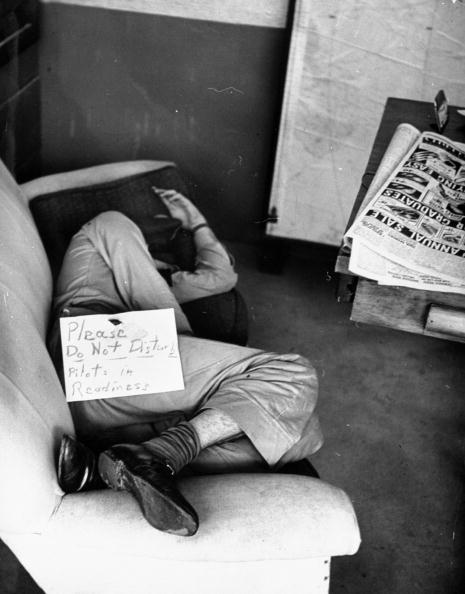
Winter argues that once you’re physically relaxed, if you get “your mind clear of any active thoughts for just ten seconds, you will be asleep.” The key to falling asleep quick is thus to stop the train of thoughts that is usually rumbling through your head. You have to stop ruminating on the regrets, worries, and problems of the day.
Winter particularly warns against having any thoughts in which you are in motion; studies done by placing electrodes on the cadets’ bodies showed that even when you simply think of performing an activity, the muscles involved in that activity actually contract. Modern studies have in fact confirmed this observation, showing that simply imagining yourself exercising activates the same parts of the brain that come online when you’re physically in motion, and actually strengthens the muscles you imagine yourself using. While there might be some benefit to using your mind to “sit and be fit,” thinking about being active while trying to go to sleep can create muscular tension and inhibit its onset.
So, when you’re looking to nod off, you just want to fill your head with the stillest, calmest of contemplations. Winter suggests three good ones to use, though you don’t have to use all three; just pick one, and if it doesn’t work, try another:
“First, we want you to fantasize that it is a warm spring day and you are lying in the bottom of a canoe on a very serene lake. You are looking up at a blue sky with lazy, floating clouds. Do not allow any other thought to creep in. Just concentrate on this picture and keep foreign thoughts out, particularly thoughts with any movement or motion involved. Hold this picture and enjoy it for ten seconds.
In the second sleep-producing fantasy, imagine that you are in a big, black, velvet hammock and everywhere you look is black. You must also hold this picture for ten seconds.
The third trick is to say the words ‘don’t think . . . don’t think . . . don’t think,’ etc. Hold this, blanking out other thoughts for at least ten seconds.”
The cadets at the pre-flight school had been broken into two groups: one which took the relaxation course, and the other a control group. The former outperformed the latter in every mentally-taxing class, discipline-requiring drill, and physically-intensive test. And after six weeks of practice, 96% of the aviators were able to fall asleep in 2 minutes or less — anywhere and anytime. Not only that, they could do it even when they drank coffee (though having caffeine in your system does make it harder), and even while the simulated noise of gunfire and cannon blasts played in the background!
After the war, Winter taught the track athletes he coached the same relaxation techniques, and became one of the greatest sprint coaches of all time, producing 102 All-Americans and 27 Olympians; at one time, his runners held all 10 world records for sprinting events.
Winter strongly believed that the wartime program for relaxation he helped develop to fight combat stress, and which athletes subsequently used to deal with the pressures of competition, was just as applicable to the tensions and fatigue civilians faced in their everyday lives.
You can use this general relaxation method to get physically relaxed whenever you’re feeling stressed out, and then tack on the mental relaxation exercise when you want to fall asleep fast. It’s handy for when you find yourself with a short window of time for a snooze; Winter thought even a 5-minute nap was incredibly refreshing. You could also use it to take a “hypnagogic nap” — a micro nap that artists like Salvador Dali used, in which you allow yourself to doze off for just a second in order to glean the creative insights that can arise on the threshold between sleep and wakefulness.
Or, of course, you can simply use this technique when you go to bed, to more quickly and contentedly enter your nightly block of sleep.
Keep in mind that being able to relax physically and mentally, and thus being able to fall asleep at the drop of a hat, is a skill, and like all skills, you shouldn’t expect to get the hang of it and have it work the first few times you try. You have to practice over and over again, until you get better and better at loosening up and calming down. That doesn’t mean you should work hard at trying to relax; that will just backfire and create tension. But you do have to practice this routine consistently.
 MaleRevivePro